




10 Ways to Reduce the Cost of Self-Adhesive Materials in B2B
January is a time when budgets start to feel the pinch in many companies. Targets and purchasing plans return, and very often — information about price increases from suppliers.
Regardless of whether material consumption is increasing or remaining at the same level, the costs of adhesive materials can suddenly spiral out of control.
At CVGS, we take a different approach. On the one hand, we actively minimise costs for our customers by analysing specifications, eliminating over-engineering, and optimising conversion, logistics and application. On the other hand, our scale of operation and optimised production mean that we are often cheaper than our competitors and, equally importantly, more predictable in terms of pricing in the long term. For customers, this means fewer surprises, more stable planning and greater control over their budget.
If your budget is no longer balanced because you have just received a pay rise, you have exceeded your cost assumptions, or you can see that this category is “running away” faster than planned, this article is for you.
We will show you where real savings can most often be found and how to implement them in practice. And if you want to go through the topic specifically, using your own data, schedule a free consultation and let’s check it out together. (click and schedule a consultation)
1) Reduction of overengineering (material that is “too good” for the need)
One of the most common reasons for high costs is overengineering, i.e. choosing materials with parameters significantly higher than required. In practice, you pay for properties that do not work in the application: too strong adhesive, too high chemical resistance, temperature, UV, etc. The solution is to adjust the specifications to the real conditions – without losing functionality.
Important: Reducing overengineering very often results in 10-30% savings on the material itself, without affecting the quality and safety of the process.

2) Purchasing audit: invoices, volumes, suppliers, commercial terms
The first quick lever is to organise purchases: what we buy, from whom, in what quantities and on what terms. Savings often result from eliminating sub-optimal volumes, reducing the number of suppliers and improving commercial terms.
Important: A purchasing audit alone can reveal 5-15% of “hidden” costs that do not result from the unit price of the material.

3) Evaluation of technical specifications vs. actual application
The next step is to “link” purchases with technology: adhesion strength, resistance to temperature, moisture, UV – and the question: are these parameters really necessary in the customer’s process? This is where overengineering most often comes to light.

4) Verification of practical use (application and storage)
Even the best material will be “expensive” if it is poorly applied or poorly stored. We analyse application errors, storage conditions, process repeatability and areas where consumption can be reduced or work simplified – often without changing the material, and sometimes using a cheaper substitute.
Important: Improving application and reducing waste can lower the TCO of a category by another 5–10%.
5) Market comparison and material alternatives
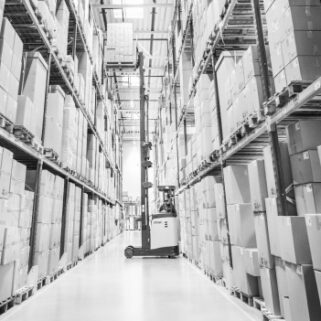
The market is vast, and price differences between manufacturers can be significant while maintaining comparable quality. By analysing the available solutions, we identify cheaper or more effective alternatives (sometimes all it takes is a change of supplier or material technology).

6) Standardisation and unification (fewer variants = lower costs)
Many companies experience “variant inflation”: similar tapes/films/foams differ in detail. This increases the cost of purchasing, storage and logistics. Consolidating the product range and orders simplifies processes and strengthens the negotiating position, which translates into better prices.
Important: Standardisation can reduce the cost of an entire category by as much as 10–25% thanks to higher volumes, simpler logistics and a better negotiating position.
7) Optimisation of logistics and inventory management
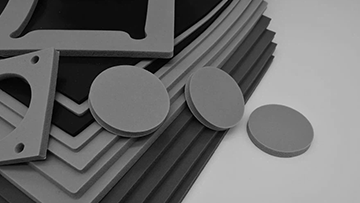
Savings are not only about the price per roll/sheet, but also the “ancillary” costs: storage, handling, risk of expiry (e.g. adhesives) or damage. We optimise schedules and ordering methods to reduce tied-up capital and inventory losses.
8) Data- and scale-based negotiations with suppliers
Thanks to our knowledge of the market and relationships with manufacturers, we can negotiate better terms: discounts, more flexible delivery dates, more favourable framework agreements and payment terms – all of which directly improve profitability.

9) Selection of more economical converting technology
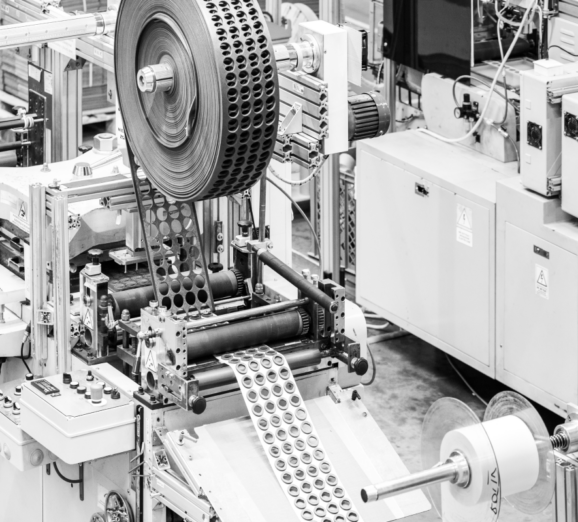
The high cost of self-adhesive materials is very often due not to the price of the raw material, but to a sub-optimally designed conversion process. Overly complicated die-cutting, excessive material losses or inefficient application methods can significantly increase the unit cost – even with good material.
That is why we analyse the entire process comprehensively — from the material selection stage, through the appropriate manufacturing technology, to the packaging and delivery of components to the customer’s production facility. The aim is to reduce waste, shorten operation times and simplify work on the end user’s side.
Examples of optimisation:
- Selection of the right format (roll/sheet/loose) — so that the material reaches production in the form best suited to the application method, without unnecessary preparatory operations.
- Matching cutting and punching technologies (e.g. rotary instead of flat) — simpler process, less waste and greater repeatability for large volumes.
- Gap Tech technology — precise placement of elements with minimal spacing, which significantly reduces material waste and lowers the unit cost.
- Kiss-cut solutions — easier and faster application, especially for manual or semi-automatic work.
- Optimisation of packaging and delivery — smaller volume, easier handling in production and shorter preparation time for application.
10) Reducing application costs at the customer’s site (pull tabs/finger lifts, automation)
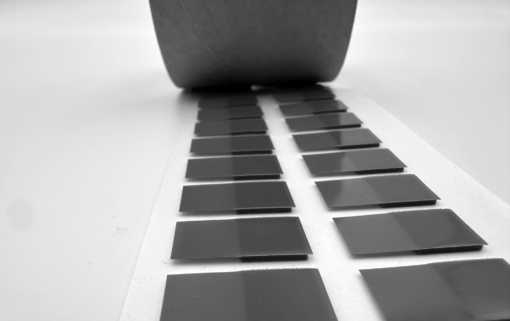
In B2B, the greatest savings are often on the “process side”, not the material side. The use of application-facilitating solutions (pull tabs/finger lifts) shortens application time, reduces errors and increases line efficiency, which has a positive impact on the work cycle time.
In addition, designing solutions for application machines reduces labour and improves repeatability.
Let’s assume:
- time savings per application: 4–15 seconds,
- annual volume: 100,000 units,
- minimum national hourly rate in Poland in 2026: PLN 31.40 gross per hour.
Conversion of time savings into hours:
- 4 s × 100,000 = 400,000 s ≈ 111 hours
- 15 s × 100,000 = 1,500,000 s ≈ 417 hours
Conversion to labour costs:
- 111 h × PLN 31.40 ≈ PLN 3,485
- 417 h × PLN 31.40 ≈ PLN 13,104
This means that the use of pull tabs alone can generate savings of between approximately PLN 3,500 and over PLN 13,000 per year in a single application point — without changing the base material or interfering with the production process.
BONUS
BONUS
11) Free consultation with a technical and sales advisor (budget consolidation and work efficiency improvement)
If you have received a signal about price increases or you see that the costs of adhesive materials are starting to exceed your budget, the quickest way to verify the situation is during a short consultation. During the conversation, the technical and sales advisor will help you identify the simplest ways to save money: from adjusting specifications (reducing overengineering) to standardisation and material alternatives, to improving application and logistics.
(click and arrange a consultation)

Summary
Savings in adhesive materials rarely result from a single move. The greatest effect is achieved through a systematic approach: adjusting specifications to real requirements, reducing the number of variants, optimising conversion and logistics, and streamlining applications. The result is lower total cost of ownership (TCO), less waste, more stable deliveries and more predictable production.
Download the catalogue
Do you want to get more information about our company, products or services? Just provide your e-mail address and we will send the cvgs company catalog to it!
free consultation

