




Adhesion vs. cohesion — anatomy of the bond

“Tape doesn’t bond on its own — it bonds an entire system. A good system can replace screws and welds.”
Tomasz Gorzawski, CVGS
An adhesive bond has no single “holding force”. It has layers, interfaces, internal stresses and at least three different mechanisms by which it can let go. Understanding what adhesion is, what cohesion is, and what the failure of each one looks like on its own — that is the condition for designing durable bonds deliberately instead of firefighting them.
Anatomy of an adhesive bond
Every bond made with adhesive tape is in fact a five-layer stack: substrate A, adhesive, carrier (in double-sided tapes — a core between two adhesive layers), adhesive again, and substrate B. Transfer tapes have no carrier — there is only a single adhesive layer between the substrates. Whichever variant is used, the durability of the whole depends on how every layer and every interface behaves.
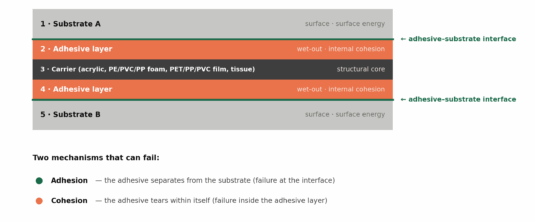
Fig. 1. Every double-sided tape bond is a five-layer stack with two critical interfaces. Failure can occur at an interface (adhesive failure) or inside the adhesive layer (cohesive failure).
Adhesion
Adhesion is the force holding the adhesive attached to a surface. Its value depends on several things: the surface energy of the substrate, the ability of the adhesive to wet the surface (wet-out), and how clean that surface is.
Adhesion is measurable — the typical methods are the 90° and 180° peel tests, which we will cover in a separate article in this series. Adhesion does not arise solely at the moment of application. With pressure-sensitive adhesives it can build over time as wet-out progresses. Its final level is therefore determined both by the application conditions and by the time the bond is given to develop.
Whether it ends up strong or weak is decided by correct application.
Wet-out — why it matters so much
Wet-out is the ability of the adhesive to flow out across a surface and penetrate its micro-roughness. Without wet-out, the adhesive touches the substrate only at the peaks of the roughness — the effective contact area is a fraction of the nominal one. With wet-out, the adhesive fills the valleys between those peaks and substantially increases the real contact area between adhesive and substrate. The term describes the behaviour of the adhesive, so it applies to liquid adhesives and to pressure-sensitive adhesives in tapes alike — with the difference that the adhesive in a tape needs pressure and time to flow into the micro-roughness of the substrate.
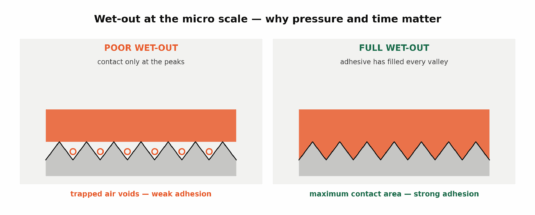
Fig. 2. Wet-out at the microscopic level. Without wet-out, contact occurs only at the peaks of the roughness — air pockets remain between them and act as defects that weaken the bond.
What influences wet-out? Above all: contact time, application pressure, and the rheological properties of the adhesive at the application temperature.
Cohesion — the internal integrity of the material
Cohesion describes the ability of a material to hold together internally under load. In adhesive bonds we usually apply it to the adhesive layer, but in tapes with a carrier — a foam carrier, for instance — failure can just as well occur inside the carrier itself.
In industrial practice, cohesion determines how the adhesive behaves under sustained load (shear). A tape with high adhesion but low cohesion “floats” — it sticks firmly, but under constant load it starts to creep until the bond fails.
If material remains on both sides after separation, it is worth no longer asking only whether the adhesive held well. The weakest link may well have been the internal integrity of the adhesive itself, or of the carrier.
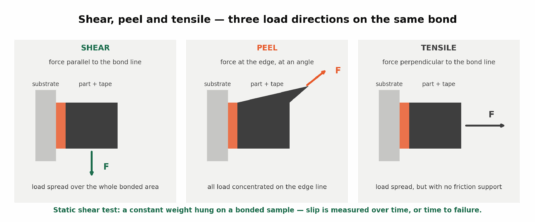
Fig. 3. Shear is a load acting parallel to the bond line — unlike peel, where the force concentrates at the edge. In a static shear test the sample is loaded with a constant weight and slip is measured over time.
The difference between the two parameters is easiest to see after separation. A single-sided tape peeled off a panel comes away in one piece and leaves no trace — that is adhesive failure: something held, but it could be released. An AFT tape bonding a steel panel to an aluminium one behaves differently: pull on the aluminium and the acrylic adhesive tears within itself, leaving residue on both panels — that is cohesive failure.
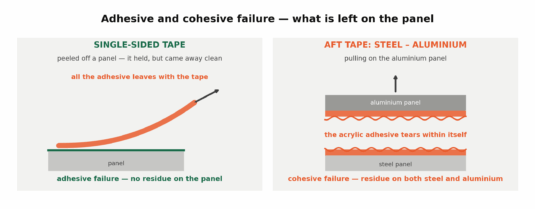
Fig. 4. Adhesive failure (the adhesive separates from the substrate) and cohesive failure (the adhesive tears within its own layer).
Adhesion is therefore not a parameter where higher is always better — it has to be matched to the application. A masking tape with too little adhesion lifts off the wall and paint creeps under the edge. One with too much comes away together with the paint, and sometimes with the plaster too: the adhesion of the tape turns out to be stronger than the cohesion of the paint film, and the colour ends up on the tape rather than on the wall.
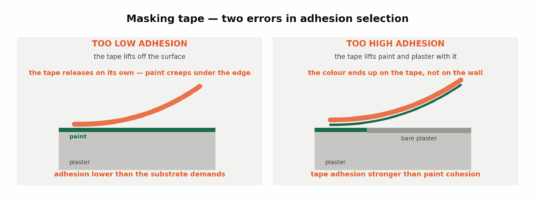
Fig. 5. Two errors in selecting the adhesion of a single-sided tape: too low (the tape releases on its own) and too high (the tape lifts paint and plaster).
The second example is car trim strips bonded with AFT tape. When the trim falls off during driving together with the tape, the adhesion to the clearcoat was wrong. When the tape stays on the vehicle and the trim has fallen off, the adhesion to the plastic the trim is made of was not matched correctly. When, during service removal, the tape remains on the clearcoat and on the trim at the same time, it is the cohesion of the material that came into play: it is lower than the adhesion to either outer layer.
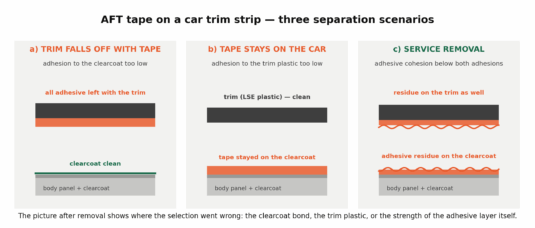
Fig. 6. Three separation scenarios for a trim strip bonded with AFT tape — the picture after removal shows which parameter was the weakest link.
This is why the choice of tape and the method of application are one decision, not two. Surface cleanliness and degreasing, a temperature inside the window recommended by the manufacturer, pressure, and time for wet-out determine whether the adhesion and cohesion we read in the technical data sheet ever materialise in the finished bond.
Download the catalogue
Do you want to get more information about our company, products or services? Just provide your e-mail address and we will send the cvgs company catalog to it!
free consultation

