




The 10 most important things you need to know before buying cork spacers for protecting glass during transport and storage
The transport and storage of glass are processes in which even minor oversights can lead to costly losses. Glass is a demanding material – it does not tolerate micro-movements, uneven pressure or poorly chosen protective materials.
One of the key elements of protection is glass spacers, and in particular cork spacers, which combine mechanical properties with the natural origin of the material.
Below, we present 10 key points worth knowing before choosing them.
- How do glass spacers work?
Understanding how spacers work is the starting point for selecting them correctly. Without this knowledge, it is easy to make the mistake of choosing a solution that theoretically protects the glass but, in practice, does not eliminate the main causes of damage.
Spacers separate the glass panes, ensuring:
- a constant distance between the surfaces,
- reduced glass-to-glass friction,
- even distribution of pressure,
- absorption/damping of the pressure acting on the glass,
- stabilisation of the glass during transport.
Their primary function is to cushion impacts and eliminate micro-movements, which are the main cause of localised stresses and micro-cracks.
- Why are spacers crucial in the transport and storage of glass?
Much glass damage cannot be linked to a single specific incident. It occurs gradually – whilst driving, stationary, during storage or handling. Therefore, glass protection must be continuous, not just temporary.
Spacers stabilise the glass package both during transport and in storage, reducing:
- scratches and cracks,
- breakage,
- complaints and material losses.
- What can spacers be made of?
The material of the spacer directly affects the effectiveness of glass protection. Different solutions work well in different conditions, so it is worth knowing the available options and their limitations.
The following are used on the market, amongst others:
- natural cork,
- PE, EVA, PUR and PVC foams,
- felt,
- hybrid materials.
In this article, we focus on cork spacers, as cork has excellent recovery properties, is resistant to ageing, does not cool water, and is derived from a natural, renewable raw material. Additionally, cork does not react chemically with glass and is resistant to pressure,
4. Spacer – two functions in one product
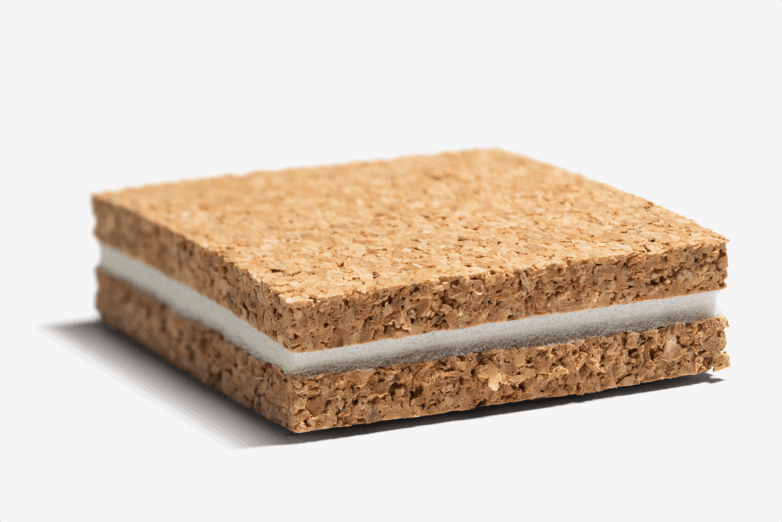
The effectiveness of a spacer is not determined solely by the material itself. The key lies in combining mechanical properties with adequate stabilisation of the spacer’s position on the glass pane.
An effective spacer consists of:
- a load-bearing layer (e.g. cork, foam) – responsible for load transfer and glass protection,
- an adhesive layer – prevents the spacer from shifting.
Maintaining a balance between these layers has a direct impact on the safety of the glass.
- What types of adhesion are there and how should they be selected?
The choice of adhesion is one of the most frequently underestimated aspects of glass protection. Too little adhesion causes spacers to shift; too much makes work difficult and can lead to problems during unpacking.
The following are used in spacers:
- self-adhesive foam – the most commonly used solution,
- low-tack – for lighter glass units,
- high-tack – the strongest type of adhesion – not recommended for application directly onto the glass
The choice of adhesion should be tailored to the type of surface being protected. It is important to consider whether the glass has a coating, what its weight is, and under what weather conditions it will be transported. This particularly concerns temperature and humidity.
- What forms do spacers come in?
The form of the spacer is important not only for protecting the glass, but also for work ergonomics and the repeatability of the packaging process.
Spacers are available as:
- loose,
- sheets,
- rolls,
- bobbins (automatic application)
- pizza rolls (automatic application).
- What should you look out for when selecting spacers?
When selecting spacers, the following key parameters should be taken into account:
- the type and weight of the glass,
- storage duration,
- transport conditions,
- temperature and humidity,
- the number of warehouse operations.
The use of solutions such as cork or foam spacers is, in a sense, a standardisation of the packaging system. A suitably selected product effectively eliminates common transport problems.
- Environmental considerations
The choice of spacers for protecting glass during transport is increasingly determined not only by technical parameters, but also by environmental impact and compliance with EU regulations. In this context, the difference between cork and foam spacers is clearly evident.
Cork spacers are made from a 100% natural, renewable and biodegradable raw material. Cork is harvested from the bark of the cork oak, without the need to fell trees, and the trees themselves store CO₂ as they grow, resulting in a very low carbon footprint for the material. Importantly, cork does not generate microplastics, and the adhesives used (PUR / LT / HT) account for only a small percentage of the total weight. As a result, cork spacers are currently considered the most environmentally friendly solution available in the glass transport industry.
Equally important is the ability to recycle and reuse. Cork spacers can be shredded and reprocessed, and in practice are often reused multiple times by different customers, with minimal degradation in quality. The product’s long lifespan means less waste and tangible environmental benefits.
- Storage of spacers and shelf life
Even the best-suited spacer can lose its properties if stored incorrectly. This applies particularly to the adhesive layer.
Spacers should be:
- stored in a dry and clean place,
- protected from extreme temperatures,
- used within the recommended shelf life.
Proper storage ensures the product retains its full functionality. Key information is provided in the product data sheets.
- How to apply spacers and what are the most common mistakes?
Last but not least, the method of applying spacers is a crucial element of glass protection. Even the best product will fail to fulfil its purpose if used incorrectly.
Correct application requires:
- a clean glass surface,
- adequate pressure,
- proper placement of spacers.
The most common mistakes are:
- too few spacers,
- incorrectly selected adhesion,
- inappropriate format or thickness,
- failure to take transport and storage conditions into account.
Spacers as part of a quality strategy
Spacers are not merely a packaging component, but a quality control tool in the transport and storage of glass. Their careful selection translates into reduced losses, more stable processes and greater confidence among end customers.
A conscious choice of spacers is not a cost, but an investment in process stability, glass safety and the trust of end customers.
Download the catalogue
Do you want to get more information about our company, products or services? Just provide your e-mail address and we will send the cvgs company catalog to it!
free consultation

