




3M VHB Tapes in the Automotive Industry—The End of the Era of Screws, Rivets, and Welds
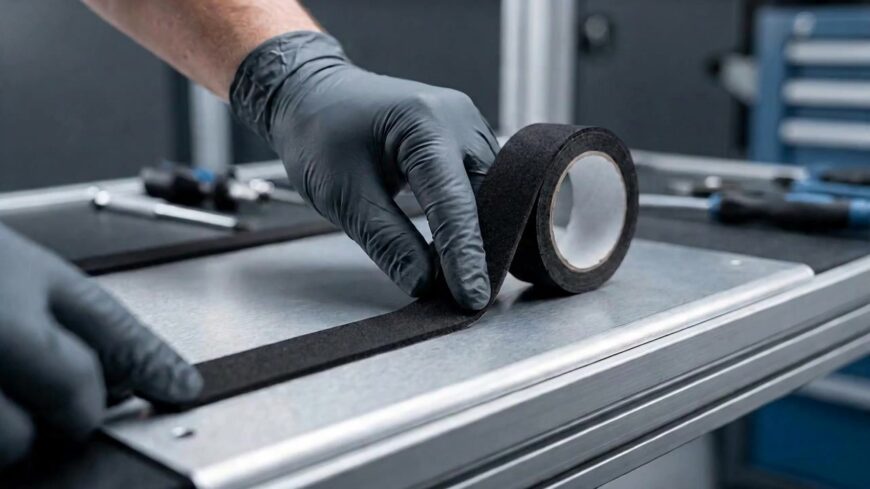
For years, the automotive industry has been searching for joining methods that are lighter, faster, and more durable than traditional mechanical fasteners. Every screw, rivet, or weld spot adds weight, increases the risk of corrosion, and creates a stress concentration point where fatigue damage can occur over time. 3M VHB tapes address these challenges by providing a structural bond that distributes loads evenly along the entire joint.
The secret lies in the viscoelastic core made of closed-cell acrylic foam. Instead of transferring forces at a single point, the tape absorbs dynamic and static stresses, distributing them across the entire bonded surface. As a result, the bond remains flexible, compensates for differences in the thermal expansion of the bonded materials, and dampens vibrations, which are one of the main fatigue factors in a vehicle.
From a designer’s perspective, predictability is key. 3M VHB tape reaches approximately 50% of its target strength just 20 minutes after being pressed into place, 90% after 24 hours, and 100% after 72 hours. The process can be accelerated by increasing the application temperature—at 65°C or higher, the bond very quickly approaches its maximum strength. This is crucial for assembly plants operating under strict production schedules.
Environmental resistance is equally important. The bond is resistant to UV radiation, moisture, thermal cycling, and solvents, while also sealing the joint against external factors. In practice, this means less galvanic corrosion, no leaks, and an aesthetically pleasing, invisible joint without protruding screw heads or weld marks.
CVGS’s role is to translate this potential into a ready-to-use, repeatable manufacturing solution. As a converter of self-adhesive tapes, we select the appropriate 3M VHB product family for the substrates and loads of a given assembly, die-cut it into shapes tailored to the part, and deliver it ready for assembly. The customer gains not only the material but also a proven process—from samples, through validation, all the way to PPAP documentation.
The transition from mechanical fasteners to 3M VHB tape is a design decision that pays off on many levels: lower weight, faster assembly, better aesthetics, and greater durability. In upcoming articles, we’ll show how this technology performs in specific automotive applications—from mounting door handles to soundproofing wheel wells.
The tape’s advantages are also evident in the numbers. Eliminating screws and rivets reduces vehicle weight, while the absence of drilling and welding shortens the assembly cycle and reduces the number of components in inventory. Lower weight, in turn, translates to lower fuel consumption or greater range in electric vehicles—which is why structural bonding fits so well with current trends in lightweight construction.
Material flexibility is also significant. The tape allows different materials to be joined without the risk of galvanic corrosion, which paves the way for mixed metal–plastic–glass structures. This is one of the main reasons why manufacturers are increasingly replacing traditional joining methods with solutions based on 3M VHB tape.
Download the catalogue
Do you want to get more information about our company, products or services? Just provide your e-mail address and we will send the cvgs company catalog to it!
free consultation

